In Bali, cremation for Hindus is called Ngaben - and it's not really seen as a "sad funeral" the way many Western cultures do it. It's actually one of the most important and beautiful ceremonies here. What Ngaben means for Balinese Hindus1. Purpose: Freeing the soul
Balinese Hindus believe the soul (Atma) gets trapped in the physical body. Cremation is done to release it so it can go to the upper realm, be reborn, or reach Moksha - freedom from the cycle of rebirth.
If it's not done properly, people believe the soul might struggle on its spiritual journey. en.wikipedia.orgdaungift.medium.comhollywoodforever.com2. It's a celebration, not mourning
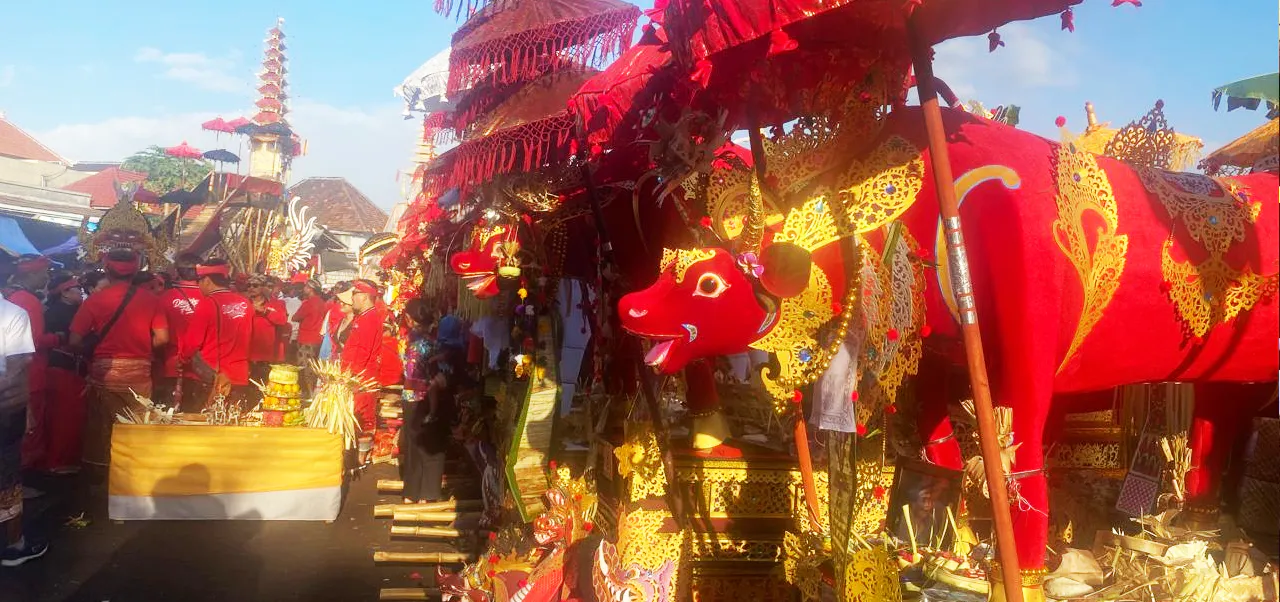
When you see a Ngaben, there's gamelan music, offerings, hundreds of villagers in traditional clothes, laughter, and a big procession. The body is carried in a tall tower called a bade and a decorated coffin called a lembu - often shaped like a bull, lion, or mythical animal depending on caste.
The idea is to help the deceased move on happily, so there's no crying or despair. daungift.medium.comatlasobscura.comexhibitions.bgc.bard.edu3. The process Preparation: Can take months. If a family can't afford it right away, the body is temporarily buried. A priest chooses an auspicious day. Procession: The bade is carried through the streets in a zigzag pattern to confuse evil spirits. Cremation: The body is burned. Fire represents returning the 5 elements of the body - earth, water, fire, air, ether - back to purification: 12 days later, ashes are scattered in the sea or a river leading to the sea. hollywoodforever.commahavidya.catheculturetrip.comatlasobscura.com4. Community + Practical side
It's a huge, expensive ceremony with lots of labor, time, and money. Because of that, many families do Ngaben Gotong Royong - a shared/mass cremation to make it more affordable. Sometimes 100+ people are cremated together. The whole village usually helps.
The cremation ceremony is one of the obligations of children towards their deceased parents in order to return their physical bodies to their source called the panca maha buta, In Hinduism, the concept of Pañca Mahābhūta refers to the five fundamental elements that constitute the entire universe. Pañca means "five," and Mahābhūta means "great elements." These five elements are believed to be the fundamental constituents of everything in the universe, including the human body.
1. Pertiwi
Pertiwi is the lowest and coarsest element, characterized by a solid and fixed form. It is the densest element in the composition of the universe, responsible for forming landmasses and the earth's foundation, as well as defining the physical form of solid objects and matter within the natural world.
Examples of this element include soil, rocks, minerals, metals, sand, and even dust.
2. Apah
Apah is the element in the universe's composition that manifests as liquid. Oceans, rivers, lakes, springs, and other water-bearing or liquid entities represent this element.
3. Teja
Teja is the element associated with heat. Anything involving heat or temperature falls under this element.
In the universe, the Teja element is found in solar heat, volcanic lava, fire, and similar phenomena. Teja acts as the source of the light that illuminates all objects and matter within the universe.
4. Bayu
Bayu is the element in the universe manifesting as air, gas, wind, and the like. Fundamentally, the Bayu element is formless, colorless, and tasteless; however, its presence can be perceived through the senses of living beings.
5. Akasa
Akasa is the final—yet most fundamental—element, representing an intangible void. Concepts such as space, the cosmos, and the soul serve as examples of this element. Akasa is understood as the vessel or container for the various cycles and processes occurring within the universe.
The largest mass cremation in Nusa Penida will be held on August 7, 2026 in the Sebunibus traditional hamlet, Sakti Village, Nusa Penida. This event will be held by approximately 73 people with a joint cremation event. In this case, three Bade or containers will be prepared that will be used to transport the bodies in the form of bones to the cremation place called setra. In addition to the bade, the participants of the cremation also prepare a place for the bones to be burned with various places resembling animals such as lions, bulls, fish, tigers, pigs and others with in total 70. These will be burned simultaneously together with each other in one place. Then after all the bones have become ashes, then the ashes are taken and made into symbols like humans, held a ceremony and purified to be scattered into the sea.